Every ham has had that surprise moment—tuning across 6 meters in June and suddenly hearing signals from hundreds or even thousands of kilometers away. The band that was dead an hour ago is suddenly alive with activity. This phenomenon is known as Sporadic-E (Es), one of the most fascinating and unpredictable propagation modes in amateur radio.
What is Sporadic-E?
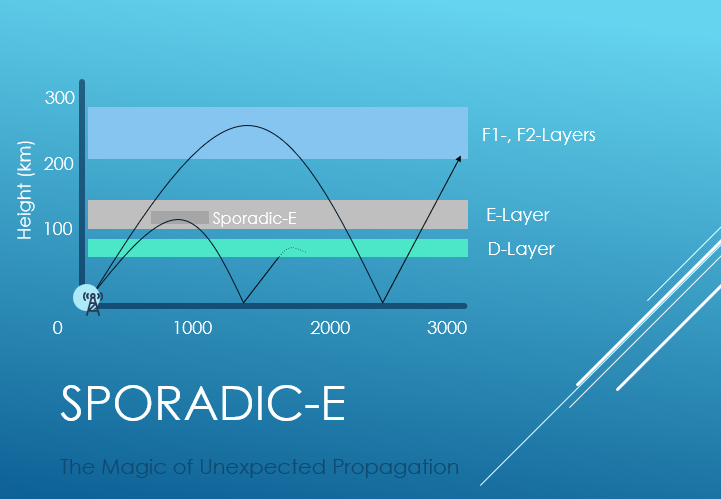
Sporadic-E occurs when small, dense patches of ionization form in the E-layer of the ionosphere, roughly 90–120 km above Earth. Unlike the broad, predictable ionization of the F-layer, these patches are irregular and localized. When they form, they can reflect VHF signals—particularly on the 6m (50 MHz) and 10m (28 MHz) bands, and sometimes even higher frequencies.
The result:
- Short-skip DX in the range of 500–2,000 km.
- Unpredictable openings that may last minutes or several hours.
- Opportunities for rare contacts on bands that are normally line-of-sight only.
When Does Sporadic-E Happen?
Es can occur at any time of year, but it follows some clear seasonal patterns:
- May through August: The strongest and most frequent Es openings in the Northern Hemisphere.
- December through early January: A secondary Es season, though typically weaker.
- Daily cycle: Openings are most common late morning and late afternoon, with occasional evening enhancements.
What Causes Sporadic-E?
Despite decades of study, the exact cause of Sporadic-E is not fully understood, but several contributing factors are known:
- Wind shear in the upper atmosphere: Winds can compress ionized particles into dense clouds that reflect radio waves.
- Meteor activity: Ionized trails from meteors can seed Es patches, especially during showers like the Perseids or Geminids.
- Geomagnetic influences: Changes in the Earth’s magnetic field may also play a role.
How to Work Sporadic-E
When an Es opening occurs, conditions can be spectacular—but you need to be ready to take advantage:
- Monitor 6 meters and 10 meters: These are the most active Es bands, often referred to as the “Magic Band” (6m) for this very reason.
- Check cluster spots and beacons: Networks like DXMaps and PSKReporter can show when Es is opening across regions.
- Look for single-hop and double-hop Es: Single-hop Es usually gives contacts up to 2,000 km, but multiple hops can stretch signals across oceans.
- Use all modes: SSB, CW, FT8, and even FM can all benefit from Es propagation.
Why Sporadic-E Matters
Sporadic-E keeps the high bands exciting even when the solar cycle is at a low point. It allows short-range DX that would otherwise be impossible, and for many hams, their first long-distance 6m QSO comes thanks to Es.
It’s also a reminder of the magic of radio: even with all our science, some parts of propagation remain unpredictable, keeping us on our toes and glued to the dial.
Tip: Keep your 6m rig on and check often during summer—you never know when Sporadic-E will turn a quiet band into a worldwide playground.